
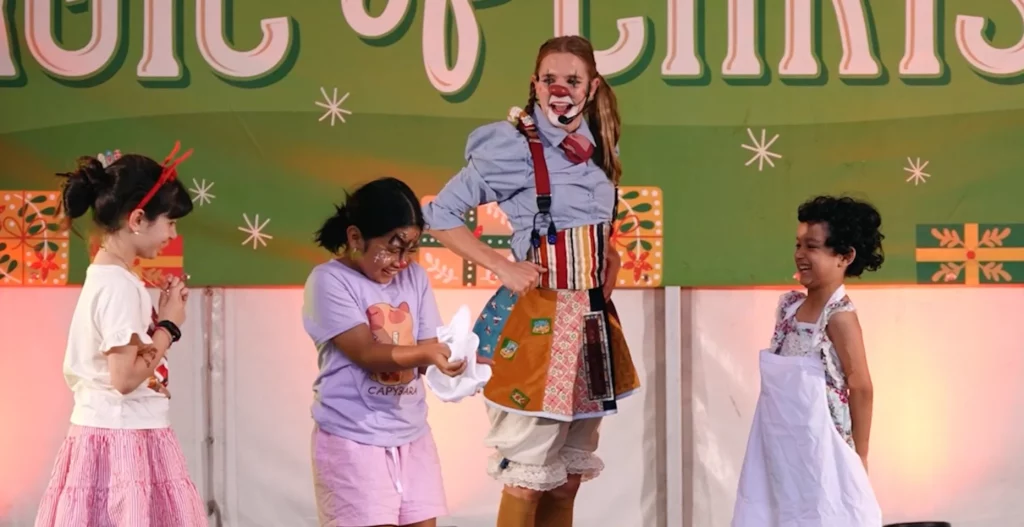
Let’s be honest: traditional language education has a bit of a vulnerability problem. We ask school-aged kids to sit at desks, look at textbooks, and repeat rigid grammatical structures. The unintended result? Students become absolutely terrified of making a mistake, which completely paralyses their ability to actually speak.
As a multilingual actress and clown based right here in Sydney, I knew there had to be a better way to bring languages to life. That is why I created three distinct educational clown theatre shows that can be performed in five different languages: Spanish, English, Portuguese, German, and French. By blending language acquisition with the chaotic, joyful art of clowning, I help kids unlock not just a new language, but vital life skills like resilience, empathy, and self-confidence.
Here is what I have learnt from touring schools across New South Wales, and why the vulnerability of performance succeeds where textbooks fall short.
The Way of the Clown: Why Failure is a Linguistic Gift
In a standard classroom, giving the wrong answer can feel like the end of the world to a young learner. But when I put on my red nose and step onto a school stage, the rules change entirely.
The clown enters the space with a singular mission: to play and connect. Clowns are completely genuine, entirely non-judgemental, and fundamentally unafraid of messing up. In fact, for a clown, failure is a massive gift because it creates an instant moment of shared laughter.
This is exactly the kind of emotional permission students need when learning a new language.
When I perform, the show is delivered entirely in the requested language. Because my character doesn’t understand a lick of English, the kids are suddenly handed a real-life purpose to communicate. They aren’t trying to pass a spelling test; they are trying to help a character solve a mystery or find a clue. The shared objective shifts from academic perfection to pure, human connection—and that is exactly when the language barriers come tumbling down.
From the Back of the Room to the Centre Stage
I see the magic of this shift during every single school incursion. Even the quietest children start responding to the story with simple words like “sí,” “non,” or “ja.” Then, I’ll catch the exact moment a spark hits their eyes as they begin repeating and experimenting with more challenging words.
I’ll never forget a show I did where I invited a student up on stage to help me complete a scene. The child jumped right into the story, communicating with me entirely in German in front of the whole assembly.
After the curtains fell, the school’s German teacher ran up to me, completely floored. She told me that this particular student was incredibly shy and usually struggled to participate or utter a single word during regular classroom lessons. Yet, wrapped up in the safety of a theatrical world, that same child felt the immense pride of speaking a foreign language aloud in front of all their peers.
The Performance Pivot: Emotion Beats Vocabulary
True expertise in this field isn’t about everything going perfectly; it’s about knowing how to adapt when a live environment throws you a curveball.
I once arrived at a Sydney primary school for a performance where, due to a scheduling mix-up, the teachers hadn’t had a chance to prepare the advanced words from my resource pack with the students beforehand. I hit the stage expecting the kids to call out specific vocabulary cues, but I was met with blank stares.
Instead of stopping to correct them or panicking, I pivoted. I shifted my focus away from expected verbal responses and leaned heavily into:
- Physical storytelling and slapstick comedy
- Heightened emotional context and expressions
- Direct, intuitive eye contact with the audience
Once I stopped relying on rigid linguistic outcomes, the interaction opened up beautifully. The kids stayed completely locked into the narrative. They responded through gestures, facial expressions, and instinctive reactions, following my character’s journey without a second thought.
That day reinforced a vital truth: the emotional drive of a story is far more powerful than pre-taught vocabulary. Language is caught, not just taught.
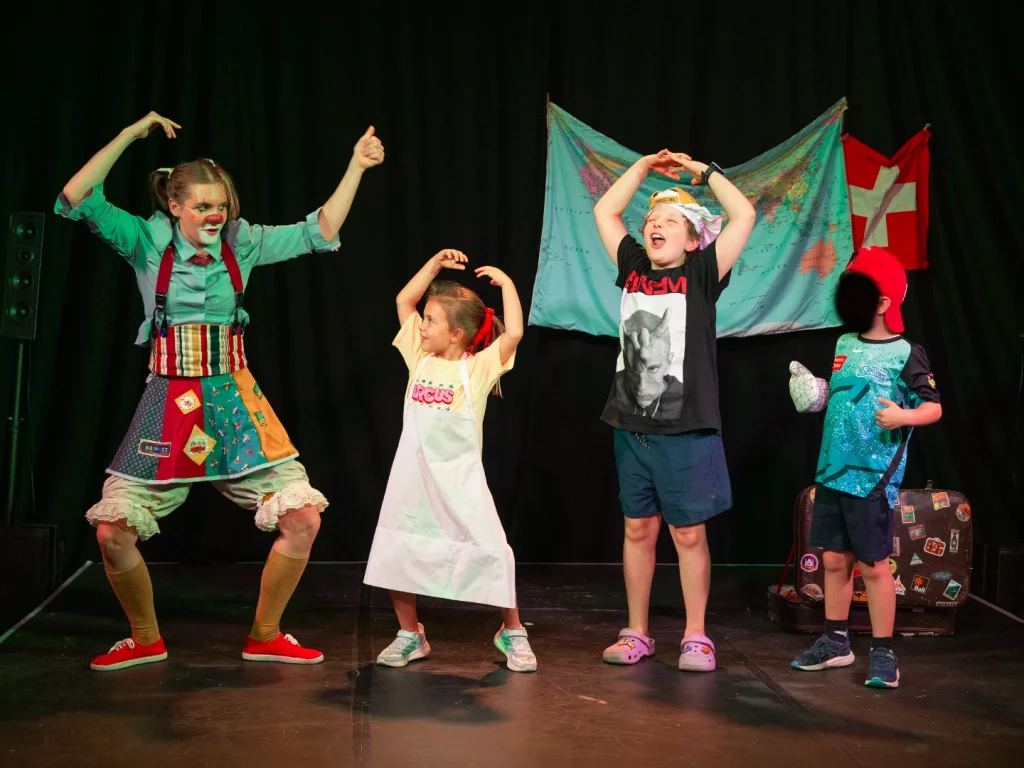
Spanish or German? The Universal Language of Engagement
People often ask me if Sydney school kids react differently to the warm, rhythmic sounds of Romance languages (like Spanish, French, or Portuguese) compared to the more structured, unfamiliar cadences of a Germanic language like German.
My answer? Not at all.
My performance data and real-world experience show that the linguistic family doesn’t matter. Because the theatrical framework makes communication intuitive rather than academic, the children don’t obsess over whether they understand every syllable. They focus on the action, the emotion, and the shared playfulness. Live theatre dissolves the fear of “not knowing enough,” inviting kids to experience language as something alive and deeply enjoyable.
Let’s Play, Learn, and Grow Together
If we want our children to become confident, emotionally intelligent global citizens, we need to take language off the whiteboard and hand it over to their imaginations.
- To find out more about my journey as an artist and educator, take a look at my About page.
- Want to bring an unforgettable language experience to your classroom? Discover my range of Multilingual Theatre Shows & School Incursions in Sydney.
- Ready to help your students build unshakeable creative resilience and life skills? Explore my interactive Theatre & Clown Workshops in Sydney.